


Industrial Relays: Interface Relay Modules
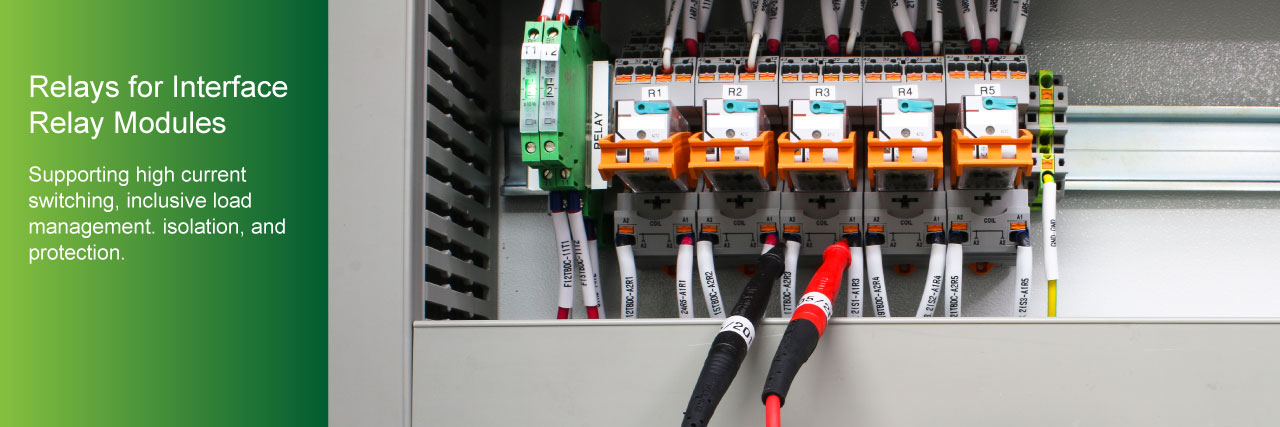
Reliable Slice I/O Relays for Modern Automation Systems
Electromechanical power relays function as the core switching component within interface relays (also called "coupling relays"), acting as a bridge between low-power control electronics and high-power industrial loads.
In modern industrial setups, these relays are typically integrated into highly compact modular housings (often as narrow as 6.2 mm) designed for standard DIN rail mounting.
Relay functionality in Interface Relay modules?
Power Relays are used in interface relays to fulfil four primary roles:
- Galvanic Isolation: The relay's electromagnet provides a physical air gap between the input (e.g., a 24V PLC signal) and the output (e.g., 240V AC motor). This prevents voltage spikes, electrical noise, or faults on the power side from traveling back and damaging sensitive controllers.
- Signal Amplification: They allow a weak control signal (often 5–24V DC at low milliamps) to switch much larger currents and voltages (up to 100 amps or 600 volts).
- Voltage Conversion: Interface relays enable a DC-powered controller to manage AC-powered equipment (or vice versa) by using the input signal to trigger a separate, differently rated output circuit.
- Signal Multiplication: A single input signal can be used to energize an electromechanical relay with multiple sets of contacts (e.g., DPDT or 4PDT), allowing one controller output to switch several independent loads simultaneously.
Common applications include:
- Industrial Automation and Manufacturing: Used in PLC output circuits to operate machinery, motors, conveyor belts, and robotic components.
- Building Management Systems: Manage lighting, HVAC (heating, ventilation, and air conditioning), and security systems.
- Power and Energy Systems: Facilitate the integration of renewable energy sources and manage power distribution systems.
- Transportation: Found in electric vehicles (EVs) and charging stations to manage high-voltage systems and safety functions.
- Medical Equipment: Used in X-ray equipment and other complex electrophysical apparatus where precise control and protection are critical.
Benefits of using FCL Components relays in relay interface modules?
Using FCL Components relays in interface relay modules provide several advantages:
- Noise suppression
- Isolation
- Long life
Comparison Table
Power Relays| Series | JS | FTR-MY | FTR-LY | NY | FTR-K1-HT |
| Contact Configuration | 1 Form A, 1 Form C | 1 Form A | 1 Form A, 1 Form C | 1 Form A | 1 Form A, 1 Form C |
| Contact rating (resistive) | 8A, 250VAC/24VDC | 5A, 250VAC/30VDC | 6A, 250VAC/ 24VDC | 5A, 250VAC/30VDC | 16A, 250VAC/24VDC |
| Coil voltage | 5-60VDC | 4.5-24VDC | 5-60VDC | 4.5-24VDC | 5-60VDC |
| Max. carrying current | 10A | 5A | 6A | 5A | 20A |
| Max. switching voltage | 400VAC/300VDC | 277VAC/125VDC | 250VAC | 270VAC/125VDC | 440VAC/300VDC |
| Max. switching power | 2,000VA/192W | 1,250VA/150W | 1,500VA/144W | 1,250VA/150W | 4,000VA/384W |
| Min. switching load | 100mA, 5VDC (gold flash) 10mA, 5VDC (gold plate) |
1mA, 5VDC | Y, E: 100mA, 5VDC V (gold plate): 10mA, 5VDC |
1mA, 5VDC | 100mA, 5VDC |
| Power consumption | 220 to 290mW | 150mW | 170 to 217mW | 120mW | 400mW to 430mW |
| Insulation resistance | Min. 1,000MΩ | Min. 1,000MΩ | Min. 1,000MΩ | Min. 1,000MΩ | Min. 1,000MΩ |
| Dielectric strength (coil to contacts) | 5,000VAC | 3,000VAC | 4,000VAC, 10mA detection current | 3,000VAC | 5,000VAC |
| Surge voltage (coil to contacts) | 10,000V | 5,080V | 6,000V | 5,080V | 10,000V |
| Operating temperature | -40ºC - +85ºC | -40ºC - +90ºC | -40ºC - +85ºC | -40ºC - +90ºC | -40ºC - +105ºC |
| Operation Time | Max. 10ms | Max. 10ms | Max. 8ms | Max. 10ms | Max. 15ms |
| Release Time | Max. 5ms | Max. 5ms | Max. 4ms | Max. 5ms | Max. 5ms |
| Mechanical life | Min. 20x106 | Min. 20x106 | Min. 10x106 | Min. 20x106 | Min. 20x106 |
| Sealing | Plastic sealed, RTIII | Plastic sealed, RTIII | Plastic sealed, RTIII | Plastic sealed, RTIII | Flux proof, RTII |
| Dimensions (W x L x H) | 10.0 x 29.0 x 12.5 mm | 5.0 x 20.0 x 12.0 mm | 5.0 x 28.0 x 15.0 mm (straight) 15.0 x 28.0 x 5.0 mm (right angle) |
5.0 x 20.1 x 17.5 mm | 12.7 x 29. 0 x 15.7 mm |
Contact Us

Find the Right Relay
Not sure which relay you need? Our technical team can help you select the best model based on coil voltage, contact rating, switching type, and panel layout. We stock a wide range of relay modules ready for fast delivery.
ASIA PACIFIC
CHINA EMEA